Posts

Engage (or survive)

Image
  There are not many "famous" school librarians. In my head, Amy Hermon, host of the podcast School Librarians United is one of them. School Librarians United had its first episode in 2018, this week marks episode 210. As Amy mentioned multiple times, only one of her episodes mentions the AASL standards. "There just isn't an interest," she claims.  The shared foundation I wanted to focus on for this interview was Engage. And in the sense that we problem solved, respected others viewpoints' and created new knowledge, we engaged. I really don't know how Hermon engages her students at school. She had a lot to say, none of it good, about the AASL standards and the state of libraries in Michigan. Even I asked direct questions where I defined the engage foundation and asked if she thought she did any of this, she didn't really answer the question. Most of this post will focus on questions 4 & 5.   4.  What are some of the challenges that you face when...
Wells_Laura_Reading_Reflection

Image
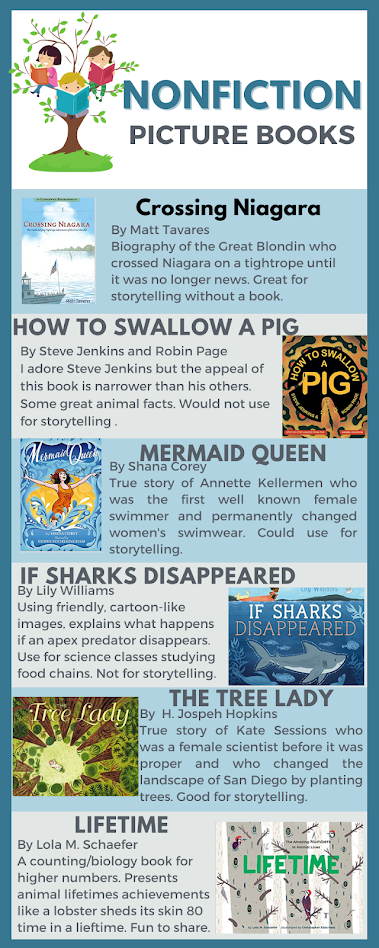
Assigned reading This week we had to read nonfiction. My favorite genre as a school librarian is nonfiction picture books. I love using them with 3rd grade and above, even with high schoolers. They are such a wonderful introduction to a topic that kids often do not know about. I need to book talk and share these to get them into the kids hands because they can get overlooked. Considering nonfiction picture books from a storytelling perspective, changes their usefulness a bit.  The books I read this week are on the left. I could envision using the picture book biographies for storytelling without the book and then showing some of the pictures afterward as Green and Del Negro suggest in our text (2010). Other books like How to Swallow a Pig won't work for storytelling without a book, would even be hard for a read aloud due to the broken up text. In this book the info is divided into short 2-3 sentence paragraphs with images scattered across the page. Kids love these kinds of informa...

Wells_Laura_Blogshare

Image
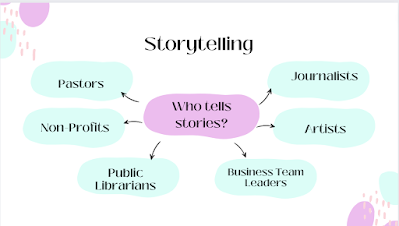
 As I've explored blogs on storytelling, I am amazed at how many of them are nonprofits with storytelling workshops. They are localized, not international. Consider the Young Storyteller 's group in CA. It looks like a super successful program that is mentor based. Or Patchwork: A Storytelling Guild based in PA, that seeks to promote the oral telling of stories. At first, I was confused by the locality of these sites, why not serve the whole country? Then I remembered that storytelling promotes community. Web of who appears to recognize the value of storyte lling  I also noticed that the organizations that did offer storyteller workshops often had testimonies from participates. Participates range from big name companies like Google or Nike to pastors, non-profits, and insurance sales teams. I kept wondering, why, until this class, has storytelling never been taught to me? As a high school English teacher, I would think storytelling would be taught. Why are businesses and no...

Wells_Laura_Free_Choice

Image
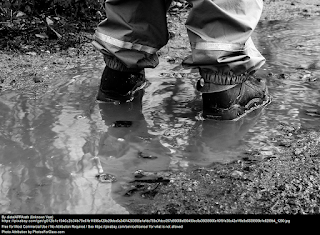
Students as Storytellers: Let's begin with a bit of background. My only experience with a storyteller who told stories orally, without a book, was with my grandmother. When we visited, each night should would put me to bed with a story. She told stories of my dad and his siblings growing up. I loved bedtime at grandma's house.  t I still remember some of them: my uncle wearing his rain boots into deep mud and getting stuck-for hours, my dad setting the curtains on fire. I remember her as a wonderful storyteller. It gave me an appreciation not just for storytelling but of the way stories can connect us to our history.  Second bit of background, I homeschooled my daughters for seven years. We used a curriculum that followed history. So art, history, literature, music history, some science etc. all radiated from a certain time period. It was cool and exhausting as a teacher/parent. For three of those years, we were in a co-op. At each meeting, three kids had to present a researc...

Wells_Laura_ Storytelling Reflection

Image
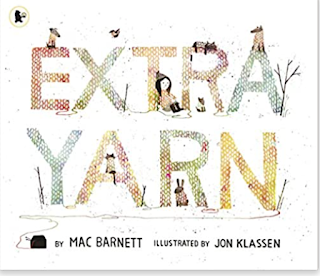
 For storytelling with a book, I wanted to shy away from books I thought kids would already know. And while humorous books are always fun to share, I am intrigued with all the folktales I have been reading and their lessons. I wanted the challenge of sharing a folktale-like story, but it needed to have great pictures. Since this is the only storytelling assignment with a book, the pictures are important and need to be part of the way the story is told. I went back and forth between multiple books but ended up choosing Extra Yarn, in part because I love the team of Barnett/Klassen. I love the illustrations in this story; they add much warmth and explanation to a hard to imagine scenario (a sweater for a truck?). Plus the use of color is delightful. The story is by Mac Barnett, and it is illustrated by Jon Klassen who always has a subtle. dry humor in his picture book illustrations (observe the animals and watch for the random appearance of the bear from I Want my Hat Back ).  O...

Wells_Laura _Reading Reflection

Image
 Let's talk about storytelling.  I want to start off by saying storytelling is new me. I am not a part of a culture that uses storytelling (just finished the YA book  Firekeeper's Daughter which is in part about Native American storytelling....definitely recommend). And I don't recall being exposed to storytellers at a library, just read alouds. So this is all very new to me.  From our textbook This week we read chapters 1-6 in Storytelling: Art and Technique by Ellin Greene and Janice Del Negro. Chapter 1 detailed histories of some famous storytellers, and what stood out to me was Shedlock's description of how carefully she chose storytellers: "Poor storytelling is more disastrous than poor story-writing" (p. 14). It would seem that, like teaching, there are some people who are just natural storytellers. While we can improve our storytelling skills, I wonder how many of us will be naturals?  In Chapter 2, I was delighted to read about Thorne-Thompson'...

Spring 2022 Reflection

Image
 Learning does not take place in isolation. It is a cumulative experience or circumstances and input. Knowledge adds to knowledge until a sort of tower of expertise is build in one area while other areas are not towers but small piles until new knowledge heightens it.  This blog was created for SLIS 761: Information Technology in the School Library Program. Simultaneously, I was taking two other library science courses. It was the second semester of my degree. I started this degree at the age of 45. I had never taken an online course. I stayed home to raise and homeschool my kids from 2009-2018. I did not even have a cell phone in 2009. Starting grad school was daunting. Technology and its uses literally exploded from the time my first was born in 2002 to when I started grad school in 2021. I felt my resumé had a giant hole in it.  Why share this background? My life of being a stay-at-home-mom made me feel like technology had raced ahead while my children grew and I was s...