Posts

Makerspace exploration: Makey Makey
Image
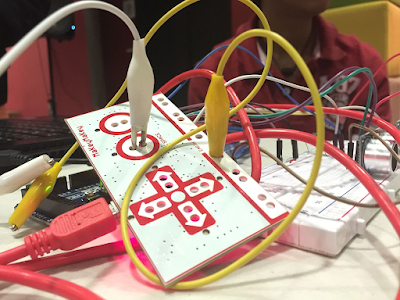
  image from Padagua,  under CC BY-SA 4.0) This week we are to explore a site that could be helpful in school makerspace. My digital curation project was on Makerspaces in schools so I've been exploring this topic for a few weeks (check it out at  this Pearltree ). One tool I kept seeing in makerspace conversations that I knew nothing about was Makey Makey.  First, I found this website from Indiana K12 Maker Space. It lists about 2 dozen instruction and example sites for Makey Makey. Through that site, I found a blogger named Julie Smith who runs the The Techie Teacher . Her video on "Academic Ways to Use the MaKey MaKey in Elementary Classrooms" is a great introduction. What I love about Makey Makey is that is is a relatively low cost way to develop a maker mindset without maintaining too many supplies or even a dedicated workspace. While there are many ways to use Makey Makey with older kids, this post is an introduction and approaches using the Makey Makey with ...

Cyberbullying

Image
A poster on Canva   Cyberbullying is almost 2 decades old now. There are books and even movies that show the power of a post, a video or a meme. Still, there are few things I learned this week that reminded me of how important this topic is.  Things I learned In reading the article, "From the Sandbox to the Inbox", I was surprised at the consistency of bullying throughout life from K-12 all the way to the workplace. Also, as a parent and a teacher observing students, I have suspected that cyberbullying was more prominent among females and was an especially big problem among female friend problems. This article confirmed my own observations.  I thought comparing the impact of bullying to burn degrees was super helpful. If I teach older kids, I think this analogy is helpful. Here is how the author described it: "First-degree burns (and low levels of bullying) are common, superficial, quick to heal, but prolonged or repeated exposure can lead to problems. Second-degree ...

Instagram for Elementary School Library

Image
For a social media account, I decided to start with Instagram. I choose Instagram because I couldn't choose TikTok ๐Ÿ˜‚. Seriously, if I wanted to use social media to connect with the kids. I would definitely use TikTok (#Booktok).  I decided to use Instagram because my target audience are the parents of my kids, and the kids too. They are young so many of them don't have their own accounts but most have parents with accounts. A poll, conducted by the University of Michigan Pediatrics Research Department, found that  50% of kids age 10-12 and 32% of kids age 7-9 (according to parents) use social media. This poll came out in October 2021 (Michigan Medicine, 2021). And what social media are they using? Most are on TikTok, with others are on Snapchat and Instagram. Parents are not on Snapchat as much and according the Pew Research Center adults between 20-29 use Instagram more than Facebook (Pew Research Center, 2021). While I could have chosen Snapchat, I don't like the platfor...

Working with Hearing Impaired students

Image
At 2 am one morning in 2015, a loud alarm startled me out of my sleep.  My alarm clock was not on. It was in my head. The beeping would not stop but eventually changed to high pitched buzz. Sleeping was difficult.  I was only 35. Seven years later it is still there. Constant ringing in your ears is called tinnitus. In my case, the cause of tinnitus is unknown. Since that morning my hearing has steadily declined. I wear two hearing aids (which are ridiculously expensive devices). Even with the aids, I regularly do not hear what people say---it depends on the room acoustics, the pitch of the person's voice, and where they look when they speak.  In recent years, as my hearing has gotten worse, I've learned to advocate for myself. I ask people to speak up,  to look up, even to remove their masks. I ask professors for captioning on videos, and I get special headphones when I go to movie theaters. Sometimes I get what I call advocation exhaustion. If I have repeated my req...

3D Printers in the Classroom (SLIS 761, post #4)

Image
Technology in schools is both a necessity and an inspiration. And the best technology integration plans acknowledge both roles. Consider Hughes' R.A.T. model of technology integration ( it was designed to help teachers develop a framework for their"growing competencies in technology integration").  According to Hughes, the transformation step is the most elusive.  I think I've found a technology for classrooms that will almost always be transformational-3D Printers. Students' learning processes while using the printers will change: they will be more involved, they will be required to think creatively, and they will be forced to accept failure sometimes and then problem solve.  Teachers will also be required to alter their instructional practices. They will have to move from a knowledge-sharing role to a learning-along-with-you role because 99% of teachers will not be able to predict how all printed models will turn out. Let's start with some basics.   What is ...

Websites to teach digital literacy

Image
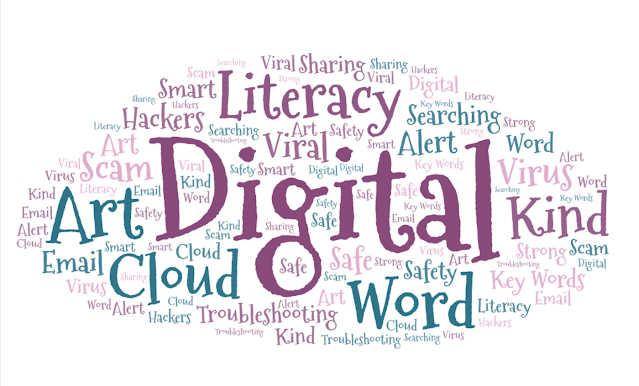
In my 3rd-5th grade building, teachers are overwhelmed. Last year, kids were either remote or in person. Classes were smaller. This year, classes are back up to around 30, teachers have to teach in person, and manage web cams for kids who are quarantined due to COVID. They are exhausted.  Yet, we need to add digital and informational literacy to daily instruction if we want to prepare our kids for the future. . Currently, most digital literacy happens by trial and error, not planned lessons. It is sporadic because it is not part of the curriculum. We have to stop assuming kids know how to use technology because it has been part of their lives since birth. Just because kids can share funny cat videos on TikTok does not mean they know how to troubleshoot if a piece of technology is not working (try shutting if off?), or how to organize papers and notes into folders so they can be found later, or how to determine if information on a website can be trusted. Honestly, many kids cannot e...

Fake News , Website Evaluation and Standards- Oh My!

Image
Photo by  Thomas Park  on  Unsplash  I ๐Ÿ’—the podcast "Fake News and Digital Literacy." I took Dr. Green's suggestion and listened to it while I walked the dog  Thank goodness for the rap song because when I got home, it offered a great summary of what had been said so I could take notes. Since I am raising teenagers and studying library science, I sometimes do informal quizzing about information habits of the teens hanging out in my house. I ask them how they evaluate websites, organize their email, determine fake news etc.  ( it all started when I took 706).  Their favorite answers are, "I just know" and "I check the end of the website address" (you know .gov, .net, etc. ) According to these teens (a very small sample really) the ending of the website is all their teachers have taught them about online source evaluation (and and never use Wikipedia they say). Ever since I took 706 and did research on digital literacy, I've been pondering how you t...